h1

So near - yet oh so far!

May 1, 2008

Here we are, May 1st already(!) - Labour Day. Yet ANOTHER public holiday and that means (deep sigh) yet ANOTHER day without progress!
There have been so many delays this month, I’m beginning to wonder if the construction at Villa Nicara will ever reach completion!

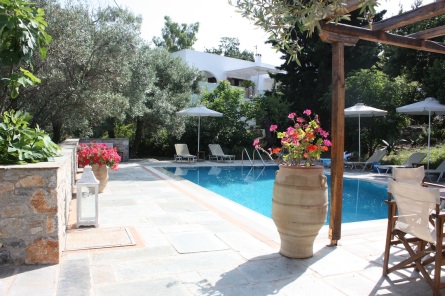
With the first guest arriving on May 18th, I’m really anxious now to return to Skiathos and check the progress that’s been made (hopefully!) in my absence. I’ve re-furbished several properties over the years so I’ve plenty of experience of the seemingly-endless, slow progress that’s inevitable in the middle of any build. But now that we’re nearing the end, it should all fall into place pretty quickly (though with only 2 &1/2 weeks to go, it may be I’m being a bit optimistic!)
I arrive back next Tuesday (May 6th) so I’ll take new photos as soon as I can and keep you posted.

I hear the weather on Skiathos has begun to brighten up at last, after the rains and wind that wreaked havoc on the island over the Easter break. The Art Exhibition had to be moved to the other end of the old port for protection from the elements and although well-attended, I understand the sales and target of funds (being raised for charity) were disappointing.

As a result, an evening musical recital was arranged in the Bourtzi itself this week, the paintings went on display again and some were finally sold. I’ve heard the Bishop from the Evangelistra Monastery himself purchased both of my contributions so I’m absolutely delighted! It’s inspired me to complete a couple of paintings that I started before I left:


‘Fishing Boats in Skiathos Harbour’ (in progress)


‘Oxi Day - Oct. 27th’ (in progress)

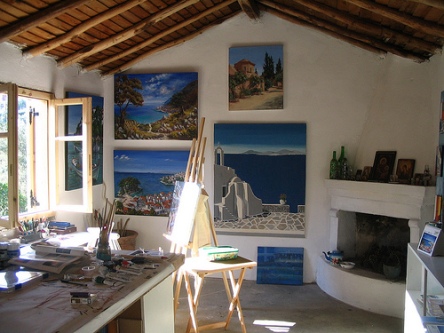
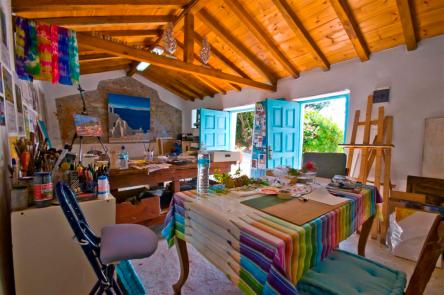
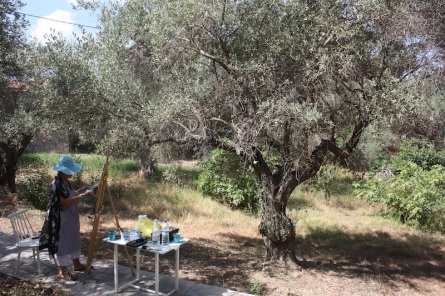
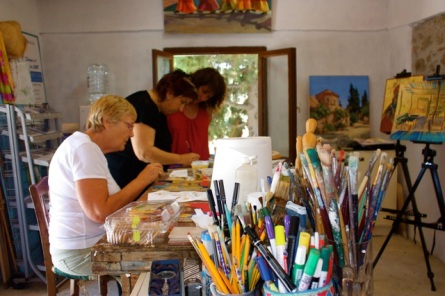
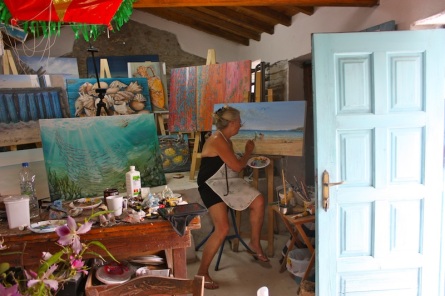
After this break, my head is now so full of new ideas and inspiration that I can’t wait to return to my studio and pick up my brushes again. Surrounded by the noise and dust of a building site or not, peace and tranquility reign supreme inside the art studio and I can’t wait to get back to it (and some sunshine - it will be very welcome after the miserable downpours and grey skies we’ve been having here in London the last few days!). Ah, Roll on Tuesday!

h1

Ευτυχές Πάσχα! ‘Happy Easter!’

April 27, 2008

Today is the Greek Orthodox Easter Sunday and, as I’m still in London, I’m so sorry not to be sharing it with all my dear friends In Skiathos. I’ve been watching events unfold on the live webcam but that’s no substitute for actually being there and witnessing the traditional festivities first-hand; following the processions, eating the ‘Avgolemono’ soup and sharing the traditional spit- roasted lamb feast & almond cakes - and making merry with the many families who are gathering together, all over the island, to celebrate this most important day in the Greek Orthodox calendar.

I’m anxious to hear how the Art exhibition went yesterday and see the photos taken on my behalf (I’ll be posting them on here for all to see as soon as I can).

So, sending Best Wishes to all my wonderful Skiathos friends, too numerous to mention all by name here but especially: Theo & Ireni Kandarakis, Despina Mtselou & Gail Stathakis (and all my fellow artists), Nikos Kondylis (my very patient builder), Elias Stamelos & Sam, Maria from ‘Maria’s Pizza’, Kostas & Giorgos from ‘Infinity Blue’ restaurant, Magda from ‘Alexandros’, Elizabeth and Steve from ‘Stathis Taverna’, Rosemary & George from ‘Varelli Taverna’, the Papas brothers from ”Victoria Cars’, all the girls in the ‘Saturday Morning Hiking’ group (you know who you are!) and last but not least, my wonderful friends & neighbours; Geoff & Lida from ‘Zorbades’, Geoff H, Richard R, Matt & Keys and Maggie & Ken.

‘Ευτυχές Πάσχα!’ ‘Happy Easter’ to all! and see you soon!

h1

Dawn breaks over Skiathos

April 25, 2008

One morning I awoke really early and in the still silence, broken only by the sound of waves lapping the shore and cocks crowing in the valley below, I climbed up onto the roof terrace to watch the dawn breaking. The sky was so incredibly beautiful I wanted to grab my paints and brushes and capture the moment but I thought if I painted what I saw, no-one would ever believe me - so I reached for my camera instead…..

PRINTS (framed or unframed) and GREETINGS CARDS of these (and other images on this site) can be purchased HERE

h1

Latest News - Building Update

April 23, 2008


Hi Everyone,

Well after 8 long weeks of camping out on a dusty (too often muddy) building site, I’ve come back to the UK for a short but much-needed break(and, at last, a HOT shower - Bliss!!). Happy to report the building/renovation works are going full steam ahead though it has been SO frustrating at times. With bad weather, general strikes and a seemingly constant stream of public & religious holidays, work hasn’t progressed as quickly as I’d hoped - but every thing’s on track and finally starting to come together.

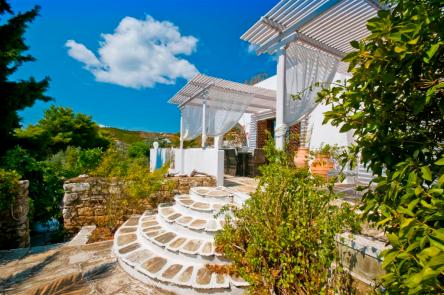
The swimming pool is almost complete:

the house still has some way to go before it’s habitable again and unfortunately the accommodation isn’t likely to be ready in time for the first guests arriving on May 18th but there are plenty of suitable alternatives nearby,

and the Art studio is all set (the shipment of art materials & equipment arrived on schedule and I’m only waiting for the electricity connection now) so I’m really excited about the prospect of classes finally getting underway mid- May.

h1

Easter Art Exhibition & Skiathos TV

April 23, 2008

I got through the most frustrating moments of the building project by retreating into the art studio to lose myself in painting. I had to complete 2 canvasses before I left, for the forthcoming Art Exhibition which (weather permitting!) will be held on the Bourtzi on (Greek) Easter Saturday; April 26th. The theme is ‘On the Wing’ and more than 20 local artists are donating their paintings of birds. Here are my contributions:

Peacock at Evangelistra

‘Peacock at Evangelistra’

‘Guinea Fowl’

There will also be a wonderful display of decorative eggs (including several beautiful antique ones) and many of the islanders and their children have been busily decorating eggs to sell on the day. There will be an introductory talk of the significance of the egg and its history in this, the most important date in the Greek Orthodox calendar. All proceeds this year will go to charity for local children with special needs. I was delighted to be invited onto the Art Committee that was set up to organize the event and along with all the usual wonderful traditional Easter festivities, that draw so many visitors to the island each year, all in all it promises to be a wonderful occasion. I’m only sorry to be missing the celebrations myself this year.

SKIATHOS TV

One of the highlights of this trip was when I was invited to appear on Skiathos TV again - this time to give a demonstration on FLOWER PAINTING, as a guest of my friend, fellow artist Despina Mtselou. With my command of the Greek language still being so poor (but improving all the time!!), she kindly translated for me as I showed various techniques using acrylics and water colour. During the 45 minute programme, I painted several spring flowers including poppies, tulips and pansies that are abundant all over the island at this time of year. As soon as I can figure out how to do it, I will add a short clip from the DVD.

This was the final and largest painting, in acrylics on canvas, of irises. It now hangs in the foyer of the TV studio!

h1

National Day Parade

April 23, 2008

Greece’s National day on Tuesday March 25th was great fun though quite a formal occasion. A parade along the Paralia (old port) by the local school children was overseen by the local dignitaries and patriotic, flag-waving spectators and was lead by the local Brass marching band. There followed a wonderful Greekfolk dance display in local traditional costumes to live music. It was a colourful spectacle, not to be missed.

h1

Καθαρή Δευτέρα: ‘Clean Monday’

April 23, 2008


On the first day of Lent, Καθαρή Δευτέρα ‘Clean Monday’ (March 10th), the Mayor hosted a party at Koukounaries beach to which more islanders turned out than ever before. We all took along our picnics and with much laughter, free-flowing wine, music and dancing, a great time was had by all. Following local tradition, the local children flew their kites and the weather was perfect with just the required amount of sunshine and wind to make it a successful, colourful and memorable occasion.

h1

Carnival

April 23, 2008

I did manage to experience other local, annual events. The first of these was the annual Carnival; a week of crazy dressing-up and wild partying culminating in a spectacular parade along the Paralia. This year the theme was on recycling for the younger children and, following tradition, the wives of local fishermen dressed-up as their husbands, complete with painted moustaches and stubble!

It was attended by just about the whole island population, who roared and cheered as they witnessed, after sunset, the burning of the ‘King of Carnival’ (a large brightly painted papier mache effigy) and his ceremonial tossing into the sea.

h1

Springtime on Skiathos

April 23, 2008

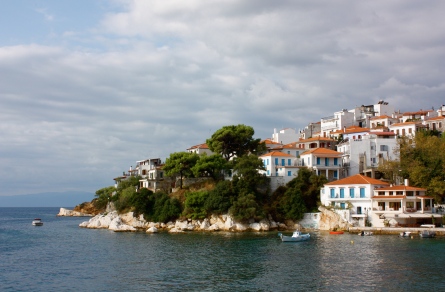
Arriving in Skiathos in mid February, I felt I’d caught the tail end of winter. Although apparently, it been a relatively mild one with only one or two really fierce wind and rain storms (and none of the heavy snows that Skiathos can experience) there was still a distinct chill in the air, the days were short and the nights were bitterly cold. The air, still thick with the pungent smell of woodsmoke, the island was completely still and incredibly peaceful. But It wasn’t long before I felt Spring was on its way. I awoke one morning to find that suddenly the island had sprung to life. The dormant meadows and olive groves had suddenly become carpeteted in spring flowers; seas of delicate lilac anemones everywhere! These were soon followed by banks of tall graceful asphodels, marguerites and wild and flag irises and still later, when the fields of bright red poppies appeared, and the swifts began their arial ballets , darting in and out of the koukounaries pines and twittering their bird-song in the Koumara bushes, I knew that Spring had indeed arrived. Up in the hills, the mists were receding to reveal the mauve Judas trees and lime-green euphorbias bursting into bloom. I think It really is my favourite time of year on the island. Not only because of the breath-taking beauty that is all around but that first rush of excitement, after the long sleep of winter, before the island really springs into action to make ready for the first influx of tourists, at Easter, is truly a wonder to behold.

The air suddenly becomes filled with the other sounds of Spring; countless strimmers and chain-saws buzzing in the valleys, cement mixers churning away in the distance, over-size lorries begin dashing all over the place, maneuvering up mule tracks to deliver their loads of sand and cement. Hammering and banging as yet more construction and renovation begins.

Skiathos town sheds its sleepy village winter persona and, seemingly overnight turns into a busy hive of activity as shop-keepers, returning from the mainland, open-up their stores, and set to sprucing-up, re-stocking their wares and make ready for a new season. Huge ferries begin to arrive in the port and empty their holds, depositing vast trucks and countless cars, laden with everything from supermarket supplies to building materials, onto the crowded quay-sides. Cafe’s open and soon fill up, brighly-coloured awnings appear, taverna chairs & tables are set out and the empty old port begins to fill up with the fishing caiques again, all brightly and newly painted after spending their winter shored-up in the boatyards.

Yes, a new season has definitely arrived and the annual circus begins…..

h1

A brief History of Skiathos

March 3, 2008

The following article, (taken directly from Jack Causton’s ‘Blue Book’) was written by the late, Betsy Barnard, an Oxford scholar, frequent visitor and sometime resident in Skiathos. It provides an insight into Skiathos’ colourful, yet often turbulent, historical past:

“Outline of history


The Northern Sporades lie on trade routes that have at all times been valuable – all the trade to Chalkis to the north and east and all the trade to the east from the gulf of Pegasae must have come this way. They had a strategic value too. The only pass from the north down into Greece on this side was at Thermopylae, but an army could land and march down through Euboea and shipe could attack Thermopylae itself.

The islanders have always been sea going and when there was peace they did well, but peace rarely lasted long and their well being never reached any height. There was what seems like an almost perpetual state of war, unrest and piracy in the Aegean. To the islanders (there was) an almost perpetual threat. Men were taken to man ships, whole herds would be killed for food and anything of any value would be appropriated. Villages could be destroyed, vineyards uprooted, olives cut down, people massacred if there was any opposition. There was rarely any power strong enough to police the seas and the islanders had to be able to defend themselves.

They had to be self-supporting too – very little could be brought in from the outside and they must have been near to starvation at times. Ultimately this seems the crucial factor. Of all the islands, Skopelos (Peparethos), was the biggest, perhaps most fertile, certainly capable of supporting more people and this perhaps explains its greater importance almost all through history.

Skiathos was probably inhabited from very early on but the island has never been excavated and so far nothing is known. There were, however, primitive people on Alonnisos (Ikos) before 3,000 BC. The people there were sailors and would at least have known the island.

There is a myth that Pelias ruled Skiathos and Skopelos (Peparethos) before seizing Iolkops and sending Jason off to find the Golden Fleece. The Argonauts probably went through the Skiathos Channel and passed north of the island on their way to Lemnos and the Black Sea. (? About 1300 BC)

The Greeks sailing to Troy probably went the same way (? About 1270 BC). People living on the island then would have seen their ships. Nearly a quarter of the ships recorded in the Iliad came from the lands round the Gulf of Pagasae and Thessaly. Achilles was born at Pteleon.

Prehistory

At Kephala the surface finds seem to indicate that there was once an ancient settlement here. Most of the pottery found is geometric and it was inhabited from at least the 11th century BC.

In the 8th century the Chalkideans colonized the island. They founded many colonies on the Chalkidiki and Skiathos would have been a useful staging post.

Early History

480 BC The first historical reference to the island is in Herodotus. (The Histories. Book VII)

Look-outs were posted to warn the Greek fleet at Artemision of the approach of the Persians.

The lookout post was probably at Pyri but there may have been another at Koukounaries. (Later, watch towers were built at both places). The Persian ships came down the Skiathos Channel and are said to have harboured at Platanias. The sea battles were fought within sight of Skiathos.

Afterwards the island was included in the Athenian alliance and was governed by Athens. The tax it

paid in 450 BC was 1,000 Drachmas. Skopelos paid as much as Chalkis did, more than 17 times as much as Skiathos, and it was clearly flourishing then.

351 BC Demosthenes urged the Athenians to use Skiathos as a base against Philip of Macedon, arguing that its fine harbour and the corn it grew. It was about this time that the island minted its own coin.

338 BC Philip took Skiathos. The walls of the Akropolis and the two watch towers are said to have been built in the second half of the 4th century and they may have been built by the Athenians in defence, or by Philip to consolidate his position.

200 BC When the Macedonians finally left they devastated everything. Probably both Kephala and the harbour town were destroyed at this time. When the Romans came they found some corn but ‘of booty, found they none’

80 BC One of the Mithradates’ pirate admirals plundered Euboae and Magnesia and stored his loot on Skiathos. The Romans just missed capturing the admiral himself and took retribution on the islanders, crucifying the slaves and cutting off the hands of the free men.

AD 128 The island did not benefit from the Romans till Hadrian declared it free. Then there seems to have been some prosperity. The islanders raised a statue to Hadrian and later (about AD 196) another to Septimus Severus. (The inscription to Septimus Severus is noe in the courtyard outside the Mayor’s office). Skiathos wine was known in Rome and a sort of fish caught here, considered a delicacy.

Byzantine Empire

Skiathos probably had a church soon after Christianity was recognised (AD 325) and it was certainly a

bishopric in AD 530. The church of Aghia Sophia at Troulos and the church of Aghia Triada on the Akropolis (both now in ruins) could have been built about this time.

Then, almost for centuries at a time, very little is recorded even for Athens and the rest of Greece, and nothing seems to be known about Athens. There were devastating raids by sea and the island was probably deserted for long periods. Still, at least by the end of the 11th century, the harbour town was lived in again and there seems to have been some prosperity then. The marble tombstone of the bishop of that time is now built into the wall of the upper church.

The Crusaders took Constantinople and partitioned the Byzantine Empire. The Ghisi (relations of the Doge of Venice) captured Skiathos and Skopelos. Their chief possession was Tinos and their court was there. In the Northern Sporades their town was at Skopelos. They built the wall around the Bourtzi.

In 1276 The Byzantines re-captured the islands.

In the 14th century there was another long period of piracy. It was probably then that the islanders found life insupportable at the harbour town and moved to Kastro.

Turkish Empire

All that is known is that when Constantinople fell to the Turks and the the islands came under the protection of the Venetian Republic, the chief town of Skiathos was at Kastro and it was there that the Governors lived.

Venetians lost the islands to the Turks in 1475 and, when they got them back ten years later, Skopelos was deserted. In 1526 the Venetian governor planted a small colony there.

Khaireddin Barbarossa took Skiathos. He probably landed at the inner harbour and brought his guns up the old road to besiege Kastro. The siege lasted 6 days. When the Venetian Governor was wounded the islanders killed him and let the Turks in. They may have hoped to avoid a massacre but it is said that all the chief men of the island were killed and 3,800 people taken as slaves.(This is about the total present population). The Turks kept the fortress intact though and the island sems to have been repopulated almost at once.It was part of the estates of the Admiral himself and the islanders had many privileges. There are signs of some prosperity

the beginning of the 17th century – Kastro was re-fortified in 1619 and the frescoes of the church of the Nativity at Kastro were painted in 1621. The icon of the Panayia of kounistria, is said to have been discovered in 1650 and the church there probably built soon afterwards. A marriage contract of 1653 sets out in detail the brides houses and land holdings as well as the jewellery and possessions she would bring with here. Ships from Skiathos traded with Egypt and the Black Sea.

Kounistria was restored in 1726 and the frescoes painted in 1741. The frescoes at Kechria were painted

in 1745. Chapels were built. A school was started near the monastery of Aghios Ioannis Krifos. People started to leave Kastro and re-establish themselves in the harbour town. Then the whole scene changed.

In 1771 There was at least one major pirate raid when Kastro was plundered and in the aftermath of the Russian/Turkish war there were numerous small acts of piracy that the islanders had not the power to resist. They themselves took to piracy at this time.

In 1794 a monk from Skiathos, son on one of the rich men of the island, came back and he and his Superior founded Evangelistria. The church was finished in 1797 and all the building completed by 1806. There were 65 cells, an olive press, stables and workshops. The monastery was founded at a time when there was great hope

for Greek Independence and became a meeting place for the klepht (guerrilla) leaders. Kolokotrones and Nikotsaras are said to have been sworn in there and the island tradition is that Nikotsaras was brought back there to die and is buried with his great sword near the mill at Lehouni.

In 1821, when the War of Independence actually started the Greeks massacred the Turks and the Turks retaliated. There were massacres in Pelion and Thessaly. Skiathos was full of refugees.

The klephts of Mount Olympus capitulated at Trikkeri and escaped to Skiathos. Here they behaved like pirates; they took over the harbour town and the staores of corn, oil and wine kept in the warehouses scoured the island and slaughtered the sheep and goats. There were 2,000 klephts here. In a petition to the Greek Admiral the islanders begged for help but even he could not do anything. In October a Turkish fleet appeared and the islanders at Kastro took in a Turkish commander. The Turks attacked the harbour town and landed near Megali Ammos but were severely defeated by the klephts under Karatassos.

The klephts had for a long time wanted Kastro as a safe place for their families and eventually Karatassos attacked and took it. As the keys were being handed over his son was shot at and there was nearly a massacre. At Kounistria the Prior was suspected of hiding a man who’d fired the shot; he was tortured and the monastery robbed.

Independence

In 1829 Turkey acknowledged Greek Independence.

Skiathos was included inside the first frontier of Greece but Volos, Pelion and Thessaly were still Turkish. People had started coming back to the harbour town in 1829, now a quarantine station was established there and many ships came to the island. In 1833 the shipyard at Aghios Giorgos began work.

There are said to have been 300 houses at Kastro and 30 churches. There was also a Turkish mosque which suggests a Moslem population at some time – though it was probably very small.

The new town was officially opened in 1839. By then 500 houses had been built and the last people left Kastro. But there was still insecurity and still pirates in the area. The last pirate raid was in 1849 when 40 men from Thessaly landed at Kechria and came up to plunder Evangelistra.

Dionisios Epifanios, son of one of the first scholars of the island, restored Kounistria and re-established it as a monastery. He may himself have written the poem by the spring. (the marble is broken and the first verse is now in the courtyard of the church itself).

In 1851 Papadiamantis was born. His stories record the ordinary life of the island as well as its traditions. Even quite small incidents have the ring of truth and many of them are probably historical. The earthquake mentioned in the ‘Fonissa’ for instance, could have been the earthquake of 1868.

Recent History

The Greeks were constantly striving to extend their frontiers and eventually (1881) got back Pelion and Volos and nearly all of Thessaly.

By the early 20th century some families on the island had become prosperous, even rich. Chapels and churches were restored. The Demotic school on the Bourtzi was built in 1906.

In 1923 there was a compulsory exchange of minorities between Turkey and Greece and 80 families from Asia minor are said to have come to Skiathos.

In 1944 the Greek guerrillas on the island captured a German caique lying in the inner harbour and took a German officer prisoner. Reprisal was inevitable. The Germans shelled the town and set fire to it. 30 houses were burnt down and another 177 burnt or damaged.

In 1964 Skiathos was scheduled as a tourist island and tourism began to be a significant part of its life.

The high school opened in 1969

In 1971 the first airstrip was completed.

In 1972 there were 120.000 officially registered visitors.”

Today, the total indigenous population of Skiathos has risen to approximately 10,000 (3,000 of which are Albanian nationals). In addition, an ever-increasing expatriate population now owns holiday and/or retirement homes on the island and there is a thriving, well-established expat community.

With a new, much larger, airport serving up to 15 charter flights a day, from a variety of European countries, throughout the high tourist season (May – October) and the newly extended port facilities, tens of thousands…(? exact figures awaiting confirmation) …of tourists either visit Skiathos or pass through on their way to Skopelos & Alonnissos, annually. Tourism is today, the main industry of the island.

h1

To answer a few questions about Skiathos

March 3, 2008

This is a second article taken directly from Jack Causton’s ‘Blue Book’ in which he answers a few of the more commonly asked questions about Skiathos:

“How did Skiathos get its name?

‘Skiathos’ means ‘Shadow of Athos’, and although it is separated from the Athos Peninsula by 150 km (90 miles) of open sea, the visibility in Greece is so amazingly clear that the 2,033 m high peak of the Holy Mountain can, on occasion, be seen from Skiathos.

How many other islands are there in the Aegean?

About 165 inhabited islands and over 1,200 which are un-inhabited.

What is so special about Skiathos?

In three words; beaches, greenery and villas. There are as many as seventy sandy beaches and coves spread out around its indented coastline and separated from each other by steep rocky headlands and one of them, Koukounaries, (‘Bay of Stone Pines’) is claimed to be the finest beach in Greece. Practically all the beaches provide excellent safe bathing and wonderful under-water swimming. Many of the Aegean islands are rocky and barren and some almost completely devoid of trees and vegetation; Skiathos is one of the great exceptions. It is a green, green island, with rolling hills chequered with dark-green pine plantations and vast silver-green olive groves and well-watered valleys shaded by giant plane, poplar and chestnut trees. There are also many varities of fruit trees and abundant natural vegetation, which includes white and purple heather, ferns, broom and evergreen arbutus unedo (strawberry bush). In spring the island is a riot of wild flowers.

What about the villas?

This is a story in itself and another article; ‘The Early days of Villa Development’ will tell you how it all started.

At present there are over 300 (in 1979- today its closer to 3,000!) attractive and well-equipped villas most of them with mains electricity, piped water and septic tank drainage and built to a standard which compares favourably with that of villas anywhere in Greece. These villas which are nearly all on sites of at least 2 stremata (half an acre) fall into several categories; the beach villa, with the tranquil Aegean only a few meters from the terrace; the ‘cliff-hanger’, built up high on a rocky cliff or headland, with steep steps winding down to a sandy cove below and magnificent views straight out to sea; and the hill-side villa, set amoungst pines or an olive grove having panoramic views over country and sea. These villas and the numerous, self-contained apartments, hotels and studios, more recently built, provide ideal holiday accommodation for families and can be rented (when not occupied by their owners) for periods of a week, a fortnight or longer.

Is there anything Skiathos lacks?

There are no archeaological remains (or none that have as yet been unearthed), no museum (update: there is a Folklore museum at Evangelistria), no casino, no sophisticated entertainment (there is now a thriving night life!, Pubs, bars, clubs and restaurants, offering a wide choice of international cuisines to suit every taste and pocket can be found both in Skiathos Town and other more recently developed self-contained resorts, such as Troulos and Koukounaries).

What is the best time to visit the island?

This depends on what is your primary interest. If this is bathing and sun-bathing then come in June, July or August when the sun normally shines all day, every day. It is however warm enough to swim in May and September and also in October and November. In spring and autumn moreover, in addition to being much less crowded, the island is at its greenest and these are the ideal times for walking. Those that want to see the wonderful wild flowers at their best and observe the abundant bird life (see separate article on ‘Flowers and Wildlife’) should come in March and April.

What is the town like?

The town, which is of course also the port, is situated on one of the finest natural harbours in the Aegean – a vast beautiful bay, which is completely sheltered from the northerly Meltemi. From the sea, the town is a most attractive sight – the white-washed red-roofed houses clustered on two low hills, the colourful awnings of the cafes and shops which face the quay; the fishing caiques and luxury yachts, moored side by side and, at one end of the main harbour, the Bourtzi Island which is approached by a small causeway. To absorb something of the atmosphere of the town read the separate article: ‘Shopping, Eating and Drinking’.

What is there to see and do in the town?

The churches in the two main squares (the ‘Upper’ and the ‘Lower’) are worth a visit, as is also the house of the famous Greek writer Alexander Papadiamantis (this has been preserved more or less as it was when he occupied it over 70 years ago). A wonderful view of the town can be obtained from the small church of Aghios Nicolas, which is on top of the hill with the clock tower on it – approached from the side waterfront (The tower also now houses the Skiathos live web-cam). There is also good bathing off the Bourtzi and if you want entertainment there are numerous bars, pubs and restaurants with live music to suit all tastes. But to appreciate the charm and warmth of this small town you must do the ordinary things; sit at a café or restaurant leisurely sipping an ouzo (accompanied by the customary plate of meze), observing the evening volta along the paralia (waterfront) or watch the fishing boats chugging in to tie up for the night; stroll through the narrow streets, where old people sit outside on their door-steps on a hot evening; saunter down the pedestrian only, cobbled main (Papadiamantis) St. lined with glittering gift and artisan shops and modern fashion boutiques and visit the many tavernas where young lads of the village perform impromptu dances to the strident sounds of the bouzouki.

What beaches should I visit?

The ‘musts’ are Koukounaries and Lalaria but there are a large number of other lovely beaches and coves on the island. The separate article ‘Bathing and boating’ will help you select the ones most suited to your requirements.

What else is there to see and do?

I maintain that you really won’t have seen the island at all unless you’ve taken a walk into the still largely unspoiled interior, meandered through one of the beautiful fertile valleys; strolled in a pine forest amidst the profusion of ferns and heather; walked along a ridge of the hills and looked down at the shimmering silver blue waters of the Aegean, far below you; visited one of the many monasteries and country churches or the remains of the old fortress town of Kastro. The article ‘Walks and rides’ will describe some of these places to you and tell you how to get there. Also of course you should also do some trips by boat – particularly one right around the island, if possible – and if you walk along the paralia in the evening you will see details of the next day’s trips put up on notice boards beside the handsome caiques which make them.

What is the main livelihood of the local community?

It’s always been olives. It was once, possibly olives, and also caique-building and fishing. It is now almost certainly, olives and tourism. Skiathos, with its 6,000 olive trees is a wealthy island by Greek standards and a good crop (harvested between October & March) could be worth as much as (£563,000 in 1979). The majority of its people have always been and still are, basically peasant farmers. One of the particular charms of this island is that the daily life of its small community goes on much as it did fifty or a hundred years ago. And the visitor, in observing it can feel he has stepped back into another age; an age of tranquillity and content. The church plays an important role in the life of the Greek people and the articles ‘Faith and Folklore’ and ‘Christos Anesti’ will give you an insight into some of the significant religious events of the year.

Is Skiathos a good place for retirement?

It’s not easy to give a straight and useful answer to this question. From the point of view of climate, the beauty of one’s surroundings and a quiet and relaxed atmosphere the answer is definitely ‘yes!’ but not everyone can live happily on a small island and if theatres, concerts or even bowl or golf play an important part in your life, Skiathos is probably not for you. Then there are always the little difficulties and strange happenings which are always cropping up, many of them caused by language misunderstandings; these are often amusing in retrospect but, at the time, liable to raise one’s blood pressure. All in all though, given the right temperament one can find happiness here – my wife and I certainly have. A hobby of some sort is essential but this can be reading, gardening, painting – or even editing Guide books!”

h1

‘Skiathos - the Shaded Isle’

March 3, 2008

Skiathos– the Shaded Isle’ (affectionately known as ‘The Blue Book’) was the first comprehensive guide to Skiathos to be written in English. It was compiled and edited by Jack Causton, one of the first ‘foreigners’ to settle on the island and who, with his artist wife, Nancy (who specialised in decorative maps and botanical drawings of the flora of Skiathos) built Villa Nicara in 1964.

His book contained contributions from some of his fellow expatriate residents - sadly, many of whom are no longer with us - and it provided an invaluable source of local history, topography, culture, custom and all-round general information on the island. There were only 3 editions ever published (in ’72, ‘74 and ’79) and as it is, alas, no longer in print (and many of the facts and observations remain valid, even today) I have taken the liberty of reproducing some of the original articles here. I shall endeavour to update any discrepancies wherever necessary and, using currently available information, update key facts, whenever possible.

My additions and corrections are shown in italics.

In his ‘Introduction’ Jack wrote:

This beautiful island has only recently been discovered. Discovered that is, by tourists. And many of the early ‘discoverers’ were from Britain – a few intrepid people who were not daunted by the lack of roads, electricity and other amenities nor by the rigorous six-hour caique voyage from the mainland, and who in the early 1960’s created a demand for the villa development, which has become such a feature of Skiathos.

Now a few years later there is an airport a (now twice) daily car ferry, (regular ‘Flying Dolphin and ‘Sea-cat’ services), adequate roads serving a large part of the island, bus and taxi services, an automatic telephone exchange (and internet cafes), and several luxury hotels and it is difficult to realise that prior to 1963, there was not a single road on the island which could take a motor vehicle and that the only means of transportation were boats and mules.

Almost simultaneously with the first roads came the first tourist brochures in English and there would seem no better way of giving those of you who have not yet visited Skiathos the ‘feel’ of the place, than by quoting form these fascinatingly worded publications, which so captivated the tourists of the early ‘60’s.

Here is an extract from a little illustrated pamphlet which was headed “Skiathos the Island of Gods”

“With warmth and sunny climate, with fine weather from March to end of October, it is an ideal spot for carefree vacations. The green hills above and the crystal clear sea below, olive groves, pine woods, lovely ports and golden sand beaches provide magnificent scenery. Lovely houses hidden among flower-covered gardens, old monasteries set amid running waters and wooded hills and picturesque white chapels, with beautiful alter screens, scattered over sheltered beaches, present to the tourist pictures if infinite beauty”

Then there was the publication entitled “ Touristic Informations” from which the following are a few selected passages;

“On arrival, an amusing, ready to serve GANG of young and old will arrange everyone in a short time”

“Meals are obtainable at accessible prices and there are many neat Tavernes with local colours which have inspired very much the great Papadiamantis, and two pastry shops on the quay, where you will find several kinds of pastries and sweets, the renouned ‘BAKLAVA’, Almond candies and during the first fortnight in August their famous doughnuts. There are also many coffee houses where you can drink the ‘Ouzo’, which is served with piquant tit-bits and delicious octopus, cooked into embers”

“At Koukounaries, with the golden sea-shore, there are handy barracks, where you will find momentary meals”

“Visitors will have the opportunity of visiting the famous MANDRAKI, a sea-shore on the north back-side.

“The memorial day of AGHIOS FANOURIOS is celebrated quite pompously, to the vigil eve participating not only the natives but also the strangers”

At this stage you may be wondering whether a small island like Skiathos (it is only about one tenth of the size of the Isle of White) can really offer all the attractions referred to above. Yet I can assure you, it can – except, perhaps, for the ‘beautiful alter screens scattered over the sheltered beaches’, which still causes me some mystification!

Skiathos is without doubt an island paradise, which can have few equals anywhere in the world, and although considerable development has taken place over the years, it is still largely unspoiled.

But for how long can this continue?

As a former Chartered Surveyor, I am acutely aware that some degree of Town Planning would very much benefit Skiathos at this crucial stage of its growth as a tourist island. Is it too much to hope that future development can be, to some extent at least, planned and controlled by the powers that be so that this little island is not ruined as so many of the beauty spots of Europe have been?

In any case, in Greece, where the spirit of ‘avrio’ (tomorrow) still prevails, almost everything is done at a fairly leisurely pace. Because of this, I believe that Skiathos – or at least a major portion of it – will remain unspoiled for a number of years more and it will continue to provide a haven for those who want to get away from the stresses and strains of their normal lives, the crowds and the traffic jams and have a quiet unsophisticated holiday in the sunshine. It is the ideal pplace to find relaxation, both mental and physical, and also a place where one can observe the treasures of nature with this small isle so richly endowed.

Some of the treasures will I hope, be disclosed to you by the articles in this book. I have included an extract from the writings of someone who knew and loved the island many years ago: Alexander Papadiamantis, one of Greece’s most famous short story writers, who was born on Skiathos and who was buried here when he died in 1911. ……”

How well Jack knew his beloved island and its inhabitants! Forty years on, development though considerable, has indeed taken a’ fairly leisurely’ pace and I’m sure he would be thrilled to learn that today much of it is still remains ‘unspoiled’ and Skiathos continues to provide a haven of peace and tranquillity, for those in search of those increasingly elusive qualities. Several major changes to the island Jack could not have envisioned (but I feel confident he would have approved of) have been afforded by funds made available following Greece’s entry to the European Union: Evangelistria Monastery and other important churches and buildings have been beautifully restored, the town’s main street and several key communal areas have been sympathetically paved and landscaped, existing roads have been improved and are well-maintained and some (but thankfully still very few!) areas of the island that were previously accessible only on foot, can now can be reached by car. Adhering to EU directives, in more ecological matters (such as waste disposal, recycling etc) a new land-fill site has just been completed. They have brought the previously ‘haphazard’ development of the island under tighter control with building regulations in particular and although there is much still to be done, there definitely appears to be in place, a clear vision; an on-going, long-term plan for Skiathos’ future, which will hopefully benefit the islanders and visitors alike, on all fronts.

The ‘Forward’ to the book was written by Air Chief Marshall, Sir Christopher Foxley-Norris GCB, DSO,OBE ,MA, RAF, formerly Chief of Defence Personnel and Logistics, British Ministry of Defence, who had himself built a villa on the island and spent many holidays there. He wrote:

“I can never quite understand why the word ‘escapism’ has recently acquired so derogatory a meaning. After all, if a man succeeds in escaping from a cell or dungeon or some other unpleasant circumstances, we appreciate his motives and applaud his determination. Why then does the same not apply to those who consider their normal surroundings; find them unpleasing and decide to make an escape from them either for ever, or at least for a while, to a more desirable place? Certainly our own decision on these lines, in 1963, has never given us a moment’s regret.

For that is what we are, we who have found full or part-time houses on Skiathos, we are escapists – but in the best sense of the word. As in fabled Camelot, we have found a place where the sun shines, the breezes blow and the rain falls in just the right proportion; where the people work long and hard but remain gay, welcoming but unvaryingly courteous; where the land is green, the sky and sea, unbelievably blue; and the grim colours of what we normally hold to be matters of importance fade rapidly to the unconsidered backgrounds of our mind, leaving at last, time for space and thought, for friendship and for thankfulness.

Greece has a way of life and an approach to it all of its own. Skiathos epitomises all that is best in it. Where else would your bank manager offer to toss you double or quits when you cash a cheque? Where else would a mousetrap, robbed cunningly of its cheese two nights in a row, catch two mice on the third night when it was left un-baited? Where else would your friends outwit you of large sums in a business deal one week and offer you the money back as a gift the next?

No – I make no apology as an escapist on Skiathos. Rather I congratulate myself; and I sympathise with those who have not had the good sense or good fortune to follow me there”

h1

ARTIST INTERVIEWS

February 22, 2008

I’ve just been interviewed!

Amazingly talented fellow-artist Elizabeth Edwards has been conducting interviews on her wonderful new Art blog

Check mine out here :Yvonne’s interview

h1

It’s SNOWING!

February 19, 2008
I’ve just heard that the island is covered in a thick blanket of snow! (Oh no! That means MORE delays!) I’m all set to fly off to Skiathos at the weekend so keep your fingers crossed for me that (beautiful as it undoubtedly is!) it will not last too long and the flights will be able to resume soon.
Kathimerini, Greece’s International English language newspaper, reported this yesterday :
” Snow blankets Greece

Dozens of villages cut off, flights cancelled due to cold spell

THANASSIS STAVRAKIS/APSnow covered many parts of Greece, including the Acropolis in central Athens, yesterday. Flights were disrupted and tens of villages, mainly in central Greece’s Evia and the Aegean islands, were cut off due to the snowfall, the result of two cold fronts moving south from Russia and Scandinavia. Authorities warned drivers to be more cautious today due to the icy conditions expected. Experts forecast improving conditions as of today.

A cold snap that hit Greece yesterday blanketed the country in snow, cutting off dozens of villages and grounding flights at Athens International Airport.

Temperatures fell to as low as -11 degrees (12 degrees Fahrenheit) in parts of northern Greece while in the capital snow fell steadily throughout the day.

Officials said that about 70 villages were snowed in late yesterday, mostly in Evia, central Greece and on the Aegean islands.

Athens International Airport closed down at about 5 p.m., cancelling domestic and international flights, and was not expected to re-open until 3 a.m. this morning.

The snowstorm, the result of two cold fronts moving south from Russia and Scandinavia, struck Athens on Saturday night.

Authorities had issued appeals for people to remain indoors but said some drivers ignored calls to take extra care on the country’s road network and this had contributed to traffic problems.

“Drivers that decided to circulate without using anti-skid chains created additional problems,” said a local government official.

“They slowed down traffic on some main roads by double parking in order to put on snow chains,” he added.

The snowfall in the capital kept many Athenians indoors over the weekend, with normally busy central streets far quieter than usual.

Other villages across the country, including on the southern island of Crete, reported a number of problems with power and water supplies.

According to television reports, mountain villages near Iraklion on Crete and other small towns on the islands of Andros and Tinos had their power cut off since midday yesterday.

The snow is becoming more dangerous for drivers as it is turning to ice, authorities warned.

Schools in Athens will remain closed, but government officials said public services will operate as normal.

However, today’s driving examinations will be cancelled.

The National Meteorological Service said it expects conditions to begin improving today…………”

My parents endured many such winters in the 25 years they lived on the island - sometimes they were completely snowed-in for days at a time! Not something one normally associates with life on a Greek island, it can, nevertheless be a magical time - everything looks SO beautiful - but only so long as you’re warm enough….

(mental note: order logs for the wood-burning stove and better pack those thermals and galoshes…….)!

h1

Doors

February 4, 2008

kastro-gate.jpg

Doors, whether they’re ornately sophisticated, triumphant works of art or, charmingly rustic, simple and more concerned with functionality (as is more typical on a Greek island), they’ve always held a particular fascination for me.

Doors are common everyday objects that all of us use everyday without even thinking about it. They’re just something to open if we want to get’ in’ and either pass through or close behind us, when we leave. Unless they’re particularly noticeable, by their beauty or architectural significance (or unexpectedly locked), they‘re rarely paid any attention at all! Yet we all spend our lives living ‘behind closed doors’,’ opening the door of our homes’ to friends, seeking’ doors of opportunity’ etc, till eventually we arrive, as we all must, at ‘Death’s door’ and, perhaps even beyond; entering the ‘Doors to the kingdom of Heaven or Hell’

They’re often symbolically endowed with ritual purposes, and the guarding or receiving of the keys to a door, or being granted access to a door can have special significance.

Doors and doorways frequently appear in metaphorical or allegorical situations, in the arts, often as a portent of change, .and in literature (The writer Stephanie Strickland says that, ‘poems are words that take you through three kinds of doors: closed doors, secret doors, and doors you don’t know are there’,

Here are some of the doors to be found in Skiathos (accompanied by the words of (some great) poets who found inspiration, in reference to the humble door:

blue-door1.jpg‘The sparrow flies swiftly, .in through one door….out through another

Similarly, man appears on earth for a little while

But we know nothing of what went on

Before his life and what follows’

- The Venerable Bede 673 – 735

‘I compare human life to a large mansion of many apartments,

Two of which I can only describe, the doors of the rest

Being as yet, shut upon me’

- John Keats 1795 – 1821

whitedoor-11.jpg‘There was a door to which I found no key

There was a veil past which I could not see’

&

‘Myself when young did eagerly frequent,

Doctor and Saint, and heard great Argument,

About it, and about: but evermore

Came out by the same Door I went in’

- Edward Fitzgerald 1809 – 1883

wood.jpg‘Men shut their doors

Against a setting sun’

- Shakespeare 1564 - 1516, ‘Timon of Athens’

‘The sweetest thing that ever grew

Beside a human door!’

- William Wordsworth, ‘Lucy Gray’, 1770 – 1850

blue-door-4.jpg‘One., two, buckle my shoe

Three, four, knock at the door’

- Nursery rhymes

‘It was a summer evening

Old Kaspar’s work was done

And he before his cottage door

Was sitting in the sun’

- Robert Southey 1774 – 1843

blue-door-5.jpg‘A trick that everyone abhors,

In little girls is slamming doors’

- Hilaire beloc 1870 – 1953

‘I seem forsaken and alone

I hear the lion roar

And every door is shut but one

And that is Mercy’s door’

- William Cowper 1731 – 1800

ivydoor-9.jpg“Is there anybody there?” said the Traveller,

Knocking on the moonlit door’.

- Walter De La Mare 1873 – 1956

‘Footfalls echo in the memory

Down the passage we did not take

Towards the door we never opened

Into the rose garden’

- T.S. Eliot 1888 – 1965

red-door.jpg‘I see a red door and I want to paint it black’

- Rolling Stones song lyrics

church-door-2.jpg

‘…….Knocking at Death’s door’

- Thomas Sackville 1536 – 1608

‘Knock, knock, knocking at Heaven’s door’

- Bob Dylan’s song lyrics